Geocoding for sites that don't have an address yet.
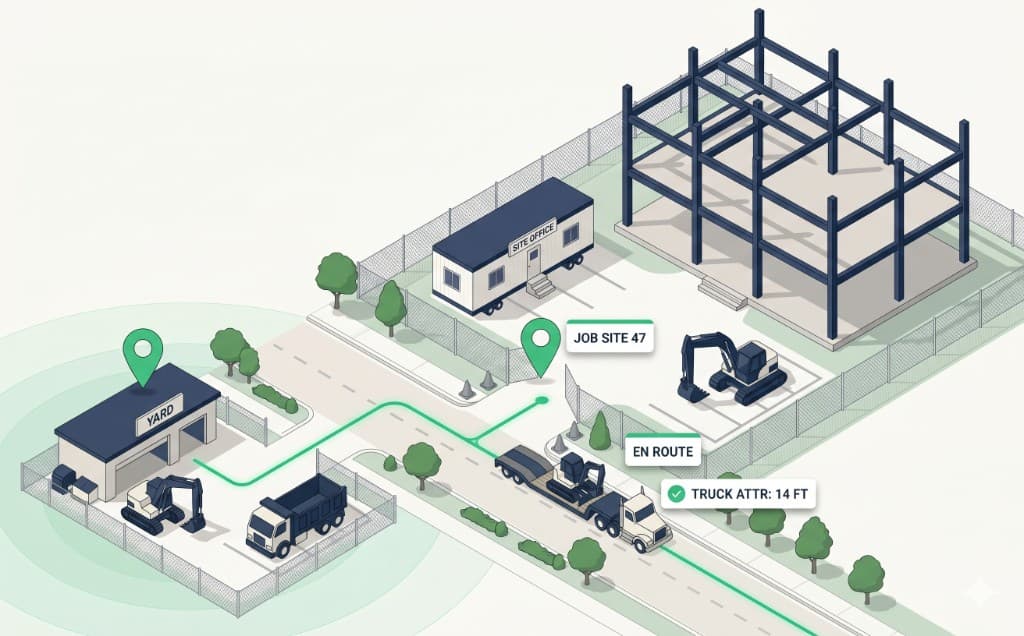
Lot numbers, mile-marker references, gate locations, and pre-address job sites, geocoded with the precision construction crews and material trucks need to actually arrive.
Job-site geocoding even without a clean address, route planning for oversized loads and heavy equipment, multi-site crew dispatch, and drive-time analysis for bidding and field operations.
Trusted by general contractors, trades, and engineering firms across North America.








Lot numbers, mile-marker references, gate locations, and pre-address job sites, geocoded with the precision construction crews and material trucks need to actually arrive.
Height, weight, axle, and length attributes baked into every route, so a track loader on a lowboy doesn't get sent under a 13-ft bridge or down a residential street with a weight limit.
Multi-stop routing for crews moving between active sites, sequenced for shift hours, equipment swaps, and handoffs across the day's work.
Drive-time isochrones from each yard, depot, and labor pool, so the bid you write reflects the crew you can actually mobilize on time.
Job-site geocoding across thousands of work orders, equipment-move routing across hundreds of moves a week, and material-delivery dispatch across dozens of sites a day, per-call pricing breaks the math at construction-network scale. Our pricing is built for it.
A consumer router doesn't know that the lowboy is over height, the concrete truck is on a tight pour window, or that the access road washes out in the rain. Routing tuned for the equipment, restrictions, and timing real construction work runs against.
Construction and engineering teams get dedicated technical support and account management. When a crew can't find the gate at 5am or a material truck breaks routing during a pour, there's a human on the other end.
Sites without an address still need to find themselves.
Construction work happens at lot numbers, mile markers, and 'the gate at the end of the gravel road' long before the postal address is registered. The teams we work with that solve job-site geocoding at intake stop losing the first hour of every shift to 'where is this site again?'.
The wrong route turns a Class 8 into a damage claim.
Consumer routing will send a tractor-trailer hauling a track loader down a residential street with a 10-ton bridge. Truck-attribute routing isn't a nice-to-have for equipment moves, it's the difference between a delivered machine and an insurance claim.
The bid lives or dies on mobilization time.
GCs and trades that bid using straight-line distance from the yard are pricing the wrong job. The teams that bid using drive-time from real road data, including the morning and evening shift windows, win more work they can actually staff.
Want the deeper technical view? Read our construction routing and site-geocoding guide →
Construction workloads, job-site geocoding across active and planned sites, heavy-equipment routing, material-delivery dispatch, and bid-stage drive-time analysis, break per-call pricing fast at scale. Our model is volume-based, designed for the call patterns construction networks actually generate. Talk to sales for a per-yard or per-project TCO comparison against your current provider.
Height, weight, axle weight, length, width, and HAZMAT class. Truck-attribute routing applies across our routing, matrix, and isochrone APIs, usable for everything from concrete trucks to lowboy hauls and oversize permits.
REST-first APIs that drop into the major construction management, project, and dispatch platforms used in the industry, including BIM, scheduling, and field-operations stacks. Most customers go live inside their existing system rather than running a separate routing portal.
API keys same day. Most construction and engineering teams have routing, geocoding, and a sample bid-time drive-time analysis running against a sample data set within two weeks, with production integration in four to six.