Delivery routing while the food is still hot.
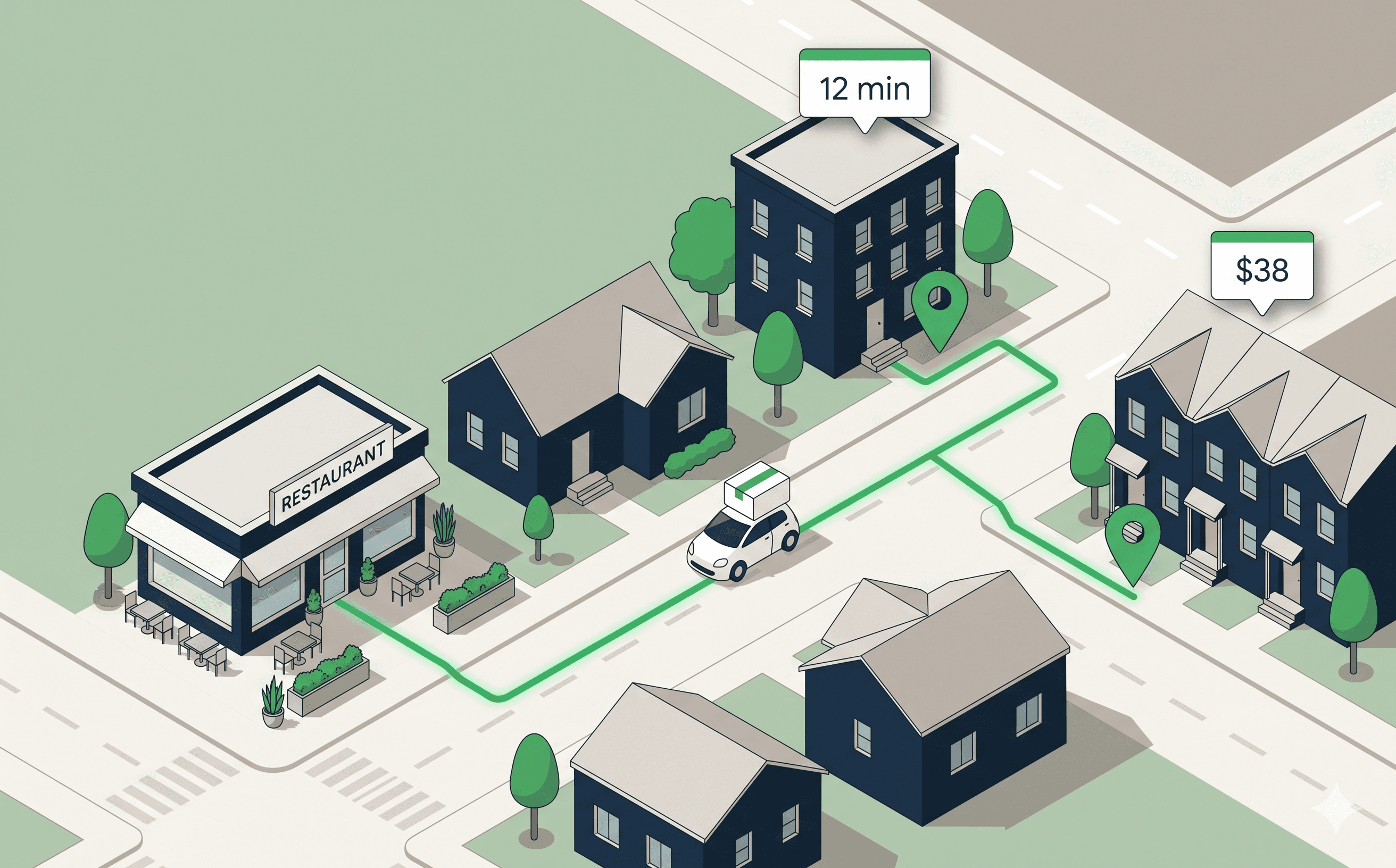
Real-time driver dispatch and multi-stop sequencing for prepared food, built for the windows that matter before the order goes cold.
Last-mile delivery dispatch, multi-drop distribution routes, branded restaurant and store locators, and ETAs that hold up while the food is still hot.
Trusted by food and beverage brands across North America.








Real-time driver dispatch and multi-stop sequencing for prepared food, built for the windows that matter before the order goes cold.
Wholesale beverage and food-service routing, multi-stop drops to bars, restaurants, and retailers, sequenced for dock time, not just distance.
Restaurant, retail, and pickup-location finders, tuned for the proximity, hours, and service-window logic guests actually search by.
Live driver tracking and ETA refreshes built on real road-network data, so the screen the customer is staring at stays honest.
Order-tracking maps and last-mile dispatch don't run a few API calls, they run thousands per restaurant per day, across millions of customer sessions. Per-call pricing breaks the unit economics. Our pricing is built for it.
A late grocery run is a refund. A late catering drop is a lost client. A late beer delivery is a lost shelf. Routing tuned for the windows the business is actually paid against.
Food and beverage teams get dedicated technical support and account management. When a delivery-tracking issue surfaces during a Friday night dinner rush, there's a human on the other end.
The cost of late isn't the refund, it's the next order.
Late deliveries don't just cost the refund and the tip. They cost the next order, the lifetime value, and the review. The brands we work with that obsess over delivery-window accuracy keep customers, not just sessions.
Apartment numbers eat margin.
A meaningful share of failed deliveries trace back to apartment numbers, building entries, and gated-community gates that consumer geocoders don't resolve cleanly. The brands that fix this on intake save more than any optimizer.
Wholesale routes win on density, not distance.
Beverage and food-service distributors don't win by driving fewer miles, they win by fitting more drops into the same shift. Routing that prioritizes drop density beats routing that prioritizes shortest path.
Want the deeper technical view? Read our delivery-routing best-practices guide →
Food delivery and customer-tracking workloads, driver dispatch, order tracking, restaurant locators, and address geocoding, break per-call pricing fast at scale. Our model is volume-based, designed for the call patterns food and beverage operations actually generate. Talk to sales for a per-order or per-store TCO comparison against your current provider.
Yes. Custom-styled basemaps, branded markers, and proximity-plus-attribute search are first-class. Most food and beverage brands run a fully branded locator without giving up performance.
REST-first APIs that drop into the major delivery dispatch, order management, and restaurant POS systems. Most customers go live inside their existing workflow rather than running a separate routing portal.
API keys same day. Most food and beverage teams have routing, geocoding, or a sample locator running in a staging environment within two weeks, with production traffic in four to six.