Routing that holds up across a tech's day.
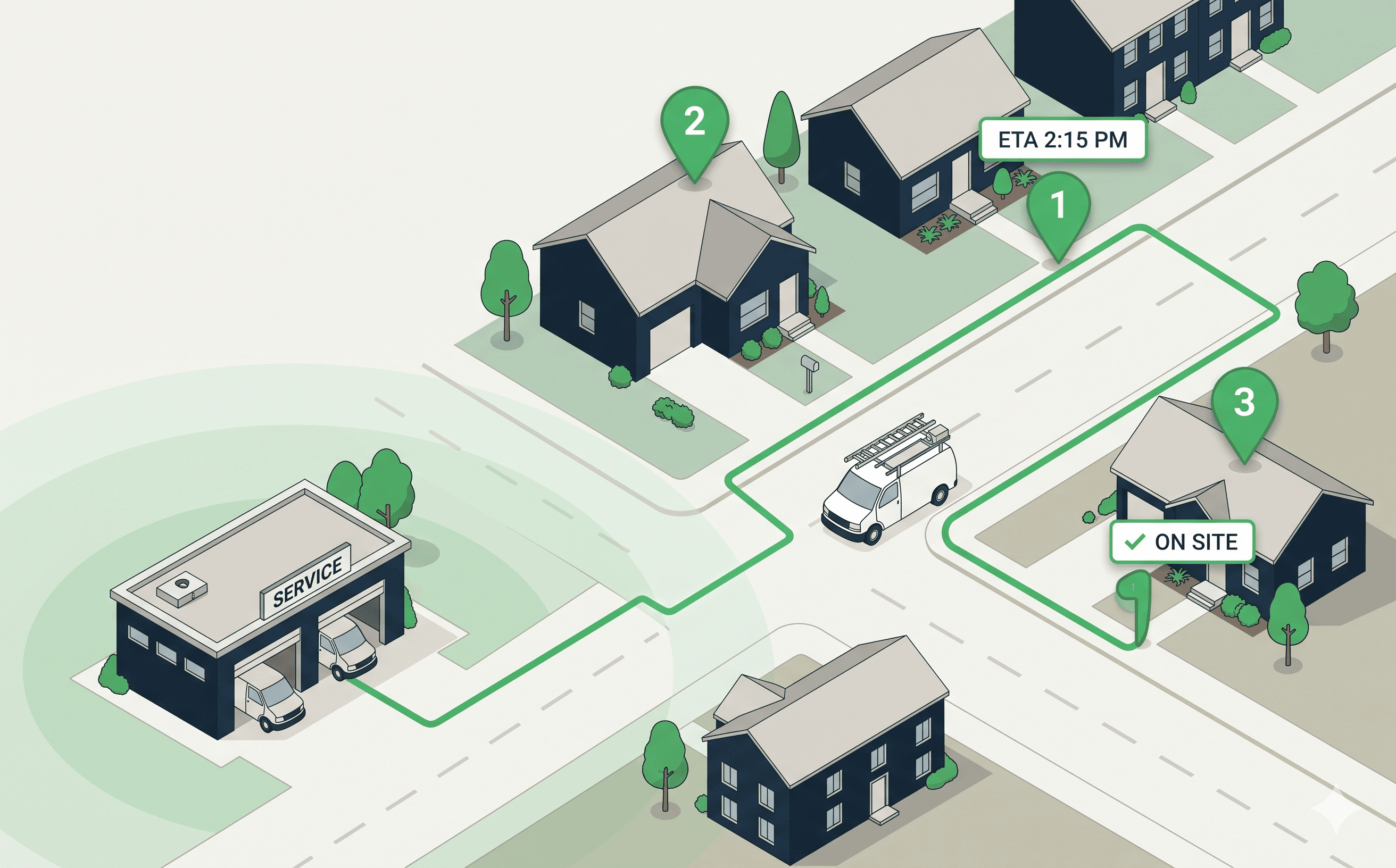
Multi-stop sequencing for HVAC, plumbing, electrical, and recurring service routes, built to absorb the emergency call that always comes in at 10am.
Multi-stop dispatch, drive-time service areas, residential address precision, and customer-facing ETAs , built for HVAC, plumbing, electrical, pest, lawn, and the full home-services trade.
Trusted by home-services brands and franchise networks across North America.








Multi-stop sequencing for HVAC, plumbing, electrical, and recurring service routes, built to absorb the emergency call that always comes in at 10am.
Drive-time isochrones around each branch, depot, or technician home base, so the quotes you accept are quotes you can actually run.
Live tech tracking and ETA refreshes built on real road-network data, so 'between 1 and 3' becomes a real arrival time, not a window.
Apartment numbers, gated communities, rural addresses, and shared driveways, geocoded with the precision residential service work depends on.
Multi-tech dispatch, customer tracking, and service-area lookups don't run a few API calls, they run hundreds per technician per day, and millions across a national franchise network. Per-call pricing breaks the math at scale. Our pricing is built for it.
A consumer router doesn't know that the 8am no-show pushes the 9am into a re-sequence. Routing tuned for the realities of a service day, emergency add-ins, parts runs, and same-day recovery.
Home-services teams get dedicated technical support and account management. When dispatch breaks at 6am during a heat-wave call surge, there's a human on the other end.
The day doesn't survive the morning plan.
Home-services dispatch built at 6am rarely survives the 9am emergency call. The teams we work with that re-sequence mid-day instead of holding the morning plan finish more jobs and run fewer overtime hours.
Zip-code service areas leave money on the table.
Service areas defined by zip codes accept jobs the truck can't reach by 11am and decline jobs that are 12 minutes from the depot. The teams that move to drive-time isochrones price what they can actually run.
The window is the experience.
A four-hour window is what the customer remembers, not the technician's tools. The teams that quote tighter, ETA-backed windows get fewer reschedules, fewer cancels, and better reviews, and most of the gain is just better routing data.
Want the deeper technical view? Read our home-services routing and ETA guide →
Home-services workloads, multi-tech dispatch, day-of re-routing, customer-tracking maps, and service-area lookups, break per-call pricing fast at scale. Our model is volume-based, designed for the call patterns home-services operations actually generate. Talk to sales for a per-tech or per-branch TCO comparison against your current provider.
REST-first APIs that drop into the major FSM platforms used in home services. Most customers go live inside their existing FSM workflow rather than running a separate routing portal.
Yes. Custom-styled basemaps, branded markers, and proximity-plus-attribute search are first-class. Most home-services brands run a fully branded locator without giving up performance.
API keys same day. Most home-services teams have routing, geocoding, and a service-area definition running against a sample data set within two weeks, with production integration in four to six.