Address-level serviceability at signup volume.
Geocoding and service-area lookups for 'is this address eligible' checks, built for the call patterns customer sign-up flows and call-center workflows actually generate.
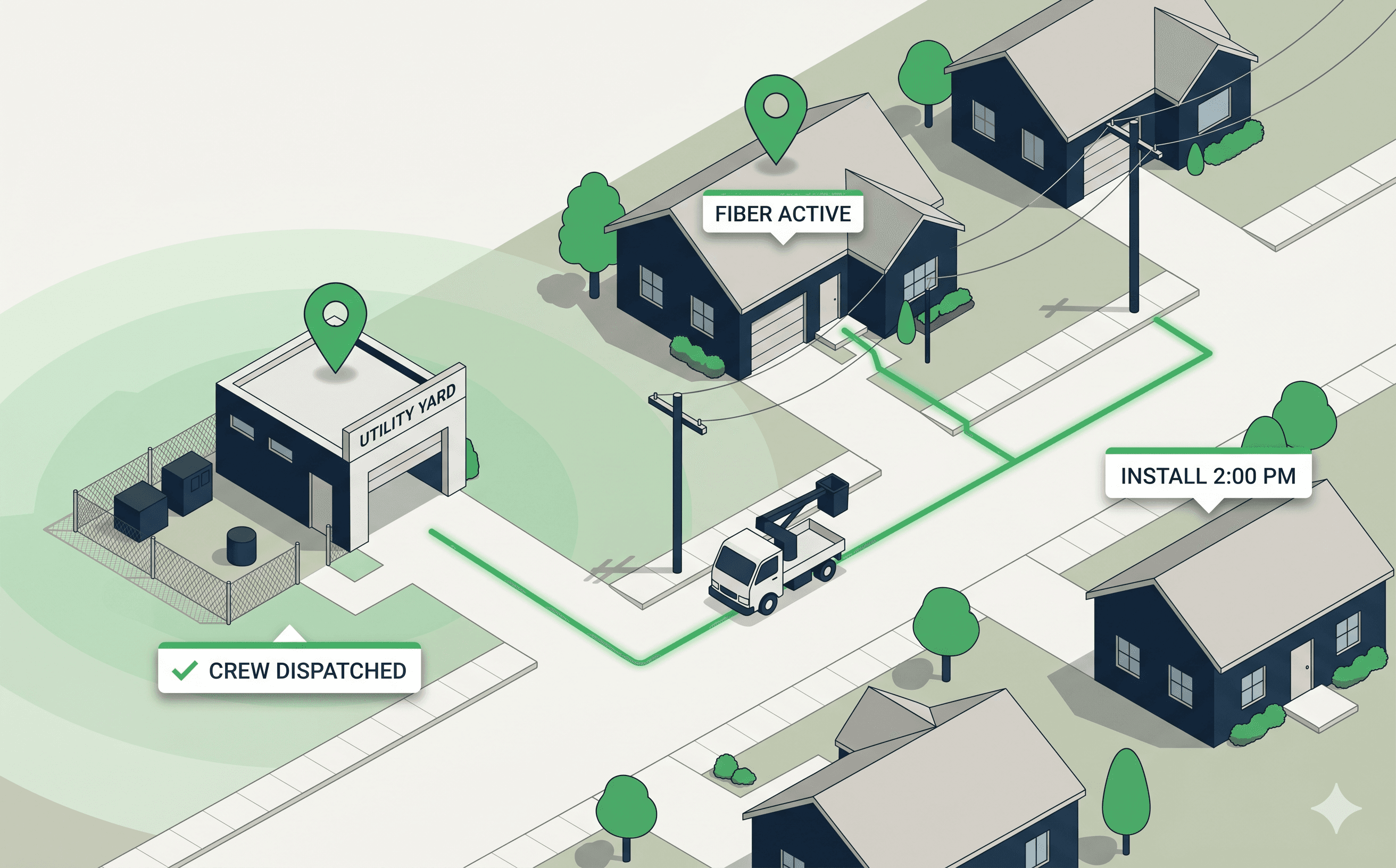
Address-level serviceability checks, multi-stop routing for line techs and meter readers, drive-time analysis for build-out planning, and surge routing for outage response.
Trusted by carriers, ISPs, and utilities across North America.








Geocoding and service-area lookups for 'is this address eligible' checks, built for the call patterns customer sign-up flows and call-center workflows actually generate.
Multi-stop routing for daily field operations, line techs, meter readers, install and repair crews, and contractor truck rolls, built so the day's work actually finishes.
Drive-time isochrones, route-of-build planning, and crew-area analysis, for fiber expansion, network densification, and field-crew territory design grounded in real road-network data.
Multi-stop crew dispatch and re-routing for outage events, built to scale when a storm changes the day's geography and the priority of every truck roll.
Serviceability checks across millions of addresses, field-crew routing across thousands of techs, and outage surges that triple traffic in hours, per-call pricing breaks the math. Our model is built for the volumes carriers and utilities actually generate.
Most telecom and utility teams already run ESRI, internal GIS tooling, or vendor stacks from major utility-software providers. Our APIs sit alongside that infrastructure, not in place of it, using the formats and protocols field-ops and engineering teams actually work with.
Telecom and utility teams get dedicated technical support and account management. When a storm lands and crew routing has to surge overnight, there's a human on the other end.
The serviceability check is the funnel.
Customers don't wait through a slow or wrong serviceability lookup, they bounce. The carriers we work with that fix geocoding and serviceability accuracy at the address-entry step convert more sign-ups and exception-handle fewer activation tickets downstream.
Every avoided truck roll is real margin.
Field operations live and die on truck-roll efficiency. The teams that re-sequence mid-day, route around the address that doesn't resolve, and absorb the emergency add-in finish more jobs per shift, and the gain is mostly routing data, not headcount.
Outage response is a routing problem before it's a crew problem.
After a storm, the constraint isn't usually crew headcount, it's getting the right crews to the right priorities on the right day, while roads are out and the priority order changes hourly. The utilities that re-route in near-real-time restore faster than the ones that hold the morning plan.
Want the deeper technical view? Read our telecom and utilities routing guide →
Telecom and utility workloads, serviceability checks at sign-up, field-crew routing, outage-event surges, break per-call pricing fast at scale. Our model is volume-based, designed for the call patterns carriers and utilities actually generate. Talk to sales for a per-address or per-truck-roll TCO comparison against your current provider.
Our APIs and tile formats coexist with ESRI ArcGIS, major utility software vendors, and open GIS standards (OGC, WMS, WMTS, vector tiles). Most telecom and utility customers run our routing, geocoding, and isochrones alongside their existing GIS investment, not in place of it.
REST-first APIs that drop into the major OSS/BSS, work management (WMS), and outage management (OMS) systems used in telecom and utilities. Most customers go live inside their existing operational stack rather than running a separate routing portal.
Yes. Routing, geocoding, and tile infrastructure are built for surge events, including post-storm crew routing, customer-portal traffic spikes during outages, and field-coordination workloads. Talk to sales for surge-capacity planning ahead of named-storm season or other anticipated events.