Address validation that catches the typo at checkout.
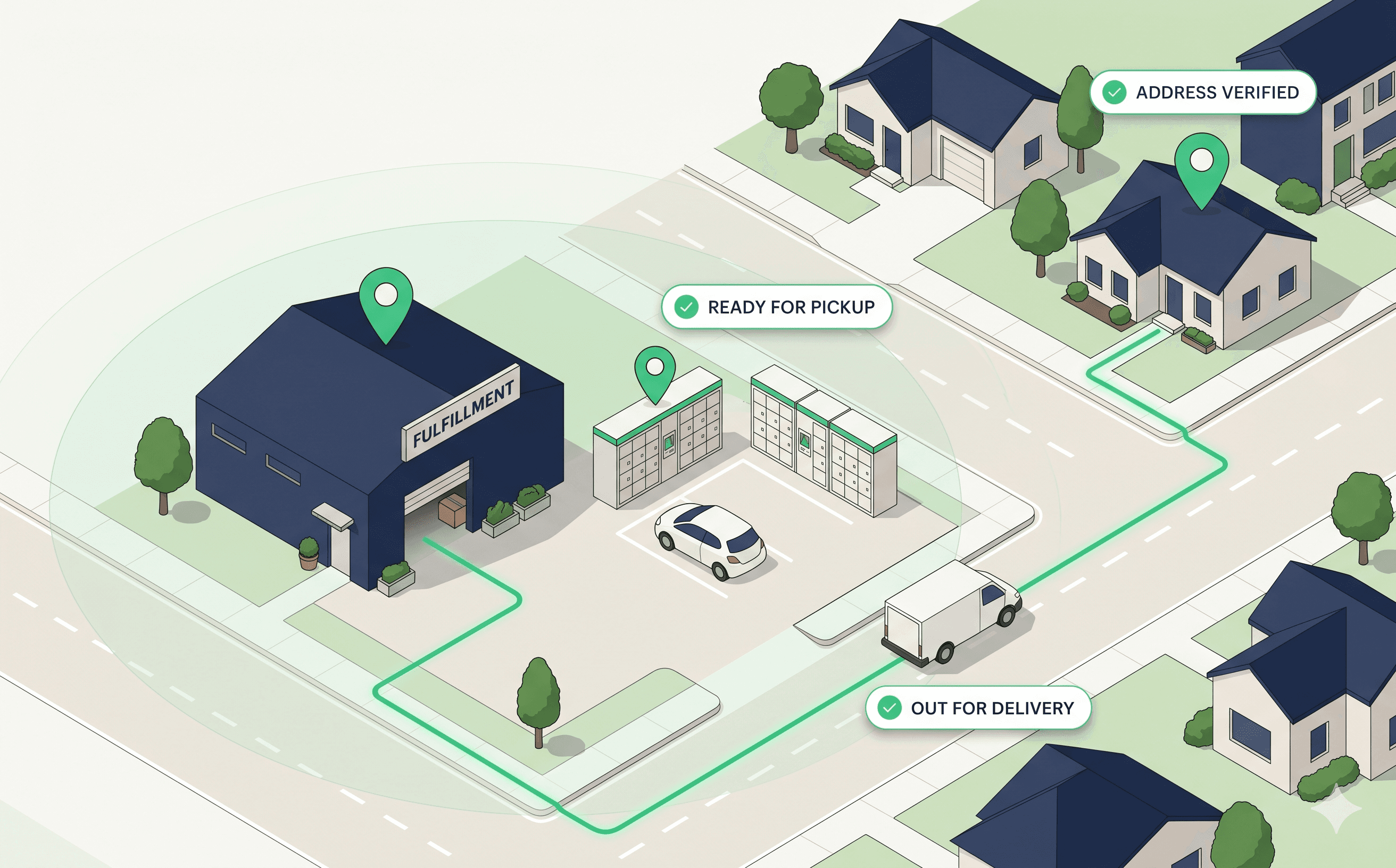
Real-time address verification, autocomplete, and standardization at the checkout step, so the package ships to a real address, not a returned one.
Checkout address verification, customer-facing delivery ETAs, last-mile routing, and pickup-point locators, built for the call volumes ecommerce and marketplaces actually generate.
Trusted by ecommerce brands and marketplaces across the world.








Real-time address verification, autocomplete, and standardization at the checkout step, so the package ships to a real address, not a returned one.
Multi-stop delivery sequencing for marketplaces, DTC brands, and quick-commerce operations, built for the drop density and time-window mix online orders actually run.
Live order tracking and ETA refreshes built on real road-network data, so the tracking page the customer is staring at stays honest until the package lands.
Branded locators for pickup points, lockers, ship-to-store, and returns drop-offs, surfaced with the proximity, hours, and capacity logic shoppers actually filter on.
Address validation at every checkout, customer-facing tracking maps, and pickup-locator searches don't run a few API calls, they run hundreds across millions of transactions and sessions, and they spike on Black Friday. Per-call pricing breaks the unit economics. Our pricing is built for it.
A failed delivery is a refund, a return, a support ticket, and a churned customer. Geocoding tuned for the residential, multi-tenant, gated, and rural addresses online checkouts actually run against, caught at the typo, not at the warehouse.
Ecommerce and marketplace teams get dedicated technical support and account management. When checkout slows during a flash-sale traffic spike or a fulfillment integration breaks at peak, there's a human on the other end.
The checkout typo is the most expensive bug in ecommerce.
A bad address doesn't fail at checkout, it fails at fulfillment, days later, after a package has shipped, returned, and an annoyed customer is on chat. The teams we work with that catch the typo at checkout save more than any optimizer downstream.
Pickup points work when they're easy to find, not just easy to ship to.
Locker and pickup-point networks underperform when shoppers can't find one near them with a clean filter. Brands with sharper locator UX, proximity, hours, capacity, convert pickup at much higher rates than the ones that just embed a list.
The tracking page is the experience after the order.
Once the order ships, the tracking page is the brand. The teams that ship live ETA refreshes built on real road data, instead of static carrier estimates, see fewer 'where is my order' tickets and better post-purchase reviews.
Want the deeper technical view? Read our checkout, delivery, and pickup guide →
Ecommerce and marketplace workloads, checkout address validation, customer-facing tracking maps, pickup-locator searches, break per-call pricing fast at scale, especially during peak retail events. Our model is volume-based, designed for the call patterns online operations actually generate. Talk to sales for a per-transaction or per-thousand-session TCO comparison against your current provider.
REST-first APIs that drop into the major checkout platforms, OMS, and carrier integration stacks used in ecommerce. Most customers go live inside their existing checkout and fulfillment workflow rather than running a separate routing portal. Address autocomplete, validation, and geocoding endpoints are designed to fit standard checkout patterns.
Yes. Custom-styled basemaps, branded markers, and proximity-plus-attribute search are first-class. Most ecommerce and marketplace customers run a fully branded locator without giving up performance.
API keys same day. Most ecommerce and marketplace teams have address validation, geocoding, or a sample locator running in a staging environment within two weeks, with production traffic in four to six.