Visit routing that respects the day.
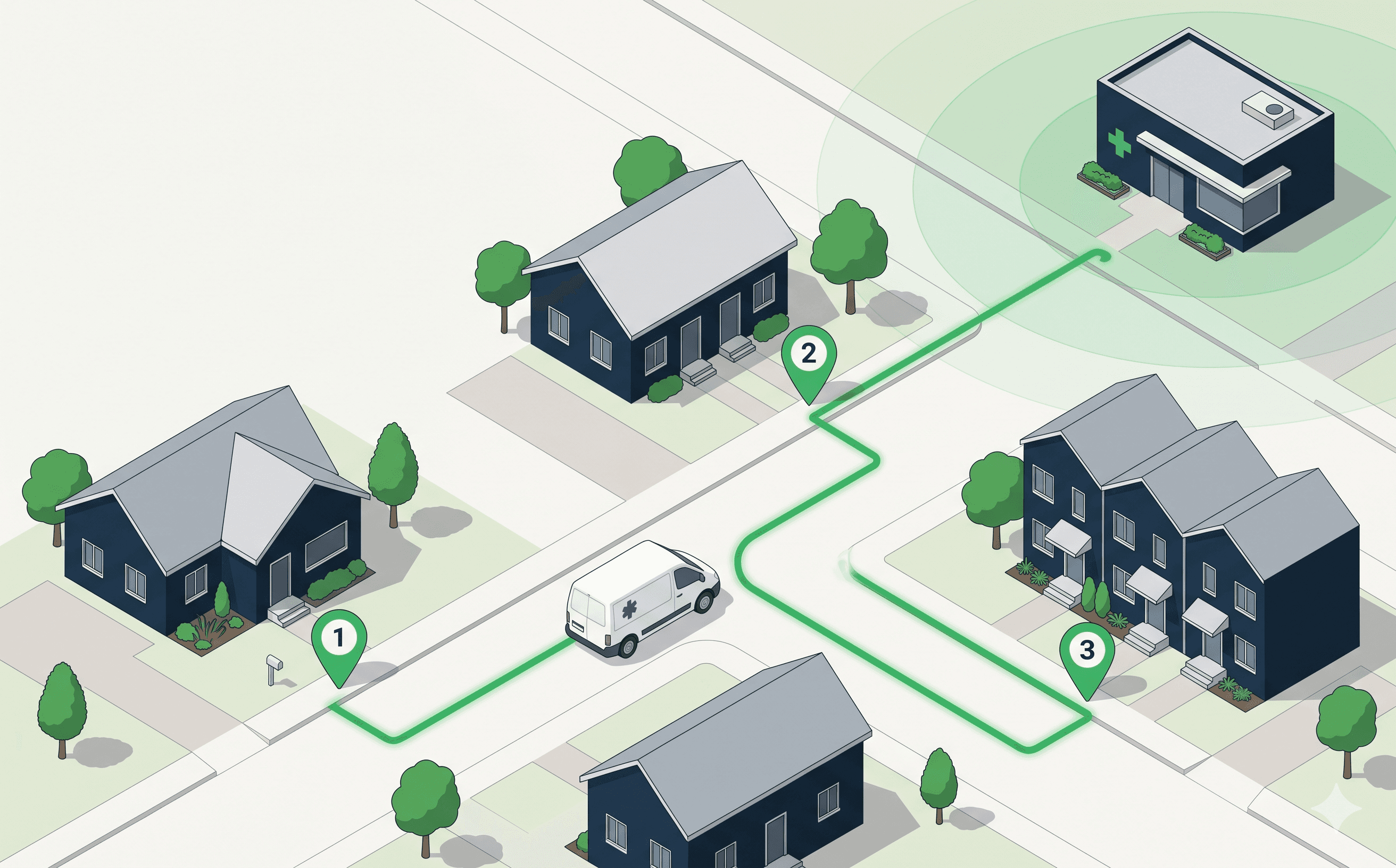
Multi-stop routing for home health, hospice, and mobile clinic visits, so caregivers spend more time with patients and less time fighting the route.
Multi-visit routing for home health, drive-time analysis for network planning, and residential geocoding tuned for the patients you serve.
Trusted by healthcare and home-care teams across North America.








Multi-stop routing for home health, hospice, and mobile clinic visits, so caregivers spend more time with patients and less time fighting the route.
Drive-time isochrones for service-area analysis, plan-design decisions, and access reporting, grounded in real road data, not radius rules of thumb.
Apartment numbers, gated communities, and rural addresses geocoded with the precision that home-based care depends on.
Lab specimen pickups, specialty pharmacy delivery, and cold-chain runs, routed for the windows that matter clinically, not just operationally.
Home health agencies don't run a few route calls, they run thousands per day across hundreds of caregivers. Network analysis runs millions. Per-call pricing breaks at that scale. Our pricing is built for it.
Consumer routing assumes a storefront. Healthcare lives at residential addresses, gated communities, multi-tenant medical buildings, and rural farmsteads. Built for those addresses.
Healthcare teams get dedicated technical support and account management. When a routing issue surfaces during a Monday morning shift, there's a human on the other end.
The wrong door is a missed visit.
Home-health no-shows are usually attributed to patient cancellations. Inside the data, a meaningful share trace back to caregivers landing at the wrong unit, the wrong building, or the wrong driveway. Address precision is a clinical-throughput problem, not just a logistics one.
Network adequacy isn't a radius.
Plan filings and access reports built on straight-line distances pass audits but miss patients. The systems that move to drive-time isochrones built on the real road network catch the gaps before members do.
Specimen routing is a clinical decision.
A specimen that misses its temperature window is a re-stick, a delayed result, and a frustrated patient. The lab networks we work with treat routing as a clinical workflow, not a back-office one.
Want the deeper technical view? Read our healthcare routing guide →
Healthcare workloads, visit routing across thousands of caregivers, network adequacy analysis, address validation at intake, break per-call pricing fast. Our model is volume-based, designed for the call patterns healthcare operations actually generate. Talk to sales for a per-program TCO comparison against your current provider.
We support customers operating under HIPAA. Our routing, geocoding, and isochrone APIs do not require PHI in the request payload, addresses and coordinates are sufficient. Talk to sales for a Business Associate Agreement (BAA) discussion and a current compliance overview.
REST-first APIs that drop into the major EHR, electronic visit verification (EVV), and home-health scheduling platforms. Most customers go live inside their existing system rather than running a separate routing portal.
API keys same day. Most healthcare teams have routing and geocoding running against a sample data set within two weeks, with production integration in four to six.